Quick answer: OSHA 29 CFR 1910.23(b)(6) requires metal ladders to be made of corrosion-resistant material or protected against corrosion. Powder coated ladders meet that duty with an oven-cured film that resists rust, chemicals and boot wear better than field paint, so rungs stay sound between inspections.
- OSHA 29 CFR 1910.23(b)(6) requires metal ladders to be corrosion-resistant or protected. Oven-cured powder coating meets this requirement.
- Four coating systems cover every environment: superdurable polyester for exterior UV, pure epoxy for chemical plants, epoxy-polyester hybrid for warehouses, and primer + topcoat for coastal or marine exposure.
- Powder coating does not apply over old paint or unknown coatings — the ladder must be stripped to clean bare metal first.
- Richards Powdercoat returns quotes within 24 business hours from Dunn, NC — call (919) 438-6103.
Table of Contents
Why Powder Coated Ladders Prevent Access Blockades and Structural Rust
The morning inspection tags another fixed ladder Dangerous: Do Not Use. Rust has lifted the paint at the rung welds, the safety cage is flaking, and the only route to the rooftop units stays closed until maintenance schedules a repaint. Every tagged ladder means a blocked access point, a new work order and one more audit finding. Powder coated ladders break that cycle because the finish goes onto clean, pre-treated metal and cures in an oven, so it holds at the welds where liquid paint fails first. Below you will find which powder fits each area of your plant and what prep the steel needs.

Does Powder Coating Satisfy OSHA 29 CFR 1910.23 Corrosion Requirements?
Quick answer: Electrostatic powder coating charges dry powder so it wraps around rungs, rails and welds, then cures into one continuous film. Compared with brushed or sprayed liquid paint, it leaves no solvent pores for moisture to enter, which means fewer corrosion findings and fewer ladders pulled from service.
Liquid paint dries as solvents evaporate, leaving microscopic pores. Moisture works through them, corrosion starts under the film and the rung loses section long before the surface looks bad. Thermosetting powder melts and cross-links during the cure, sealing steel or aluminum.
Technical Solutions and Operational Classification of OSHA-Compliant Powder Coated Ladders
Quick answer: The right powder depends on where the ladder lives. Polyester handles sunlight, epoxy handles chemicals indoors, hybrids handle impact, and multi-coat systems handle salt air. Specifying one powder for every area is the most common reason powder coated ladders fail early in mixed-use plants.
TGIC and Superdurable Polyester Coatings for Exterior Industrial Ladders
For fixed ladders, escape ladders and platforms outdoors, UV radiation is the main threat. Polyester and superdurable polyester powders keep their flexibility and color without chalking, typically at 2.5 to 4.0 mils of dry film.
Pure Epoxy Formulation for Severe Chemical Resistance and Indoors
In chemical plants and wastewater facilities, epoxy powders resist solvents, oils and washdown chemicals. Epoxy is not UV-stable, so keep it indoors or under a polyester topcoat.
Epoxy-Polyester Hybrid Systems for Mechanical Resistance and Flexibility
Rolling warehouse ladders and maintenance steps take hits from carts and dropped tools. Hybrid powders combine epoxy hardness with polyester flexibility, reducing chips along sharp edges and keeping powder coated ladders in service longer.
Polyurethane Powders and Zinc-Rich Primers for Marine or Coastal Environments
At docks, ports and coastal sites, one coat is rarely enough. Engineers commonly specify a zinc-rich primer under a polyurethane or superdurable topcoat, so a gouge does not let rust creep under the film. Our custom and multi-coat powder systems include primers, base coats and topcoats built to your spec.
Performance and Commercial Application of Industrial Ladder Coating Systems
| Coating system | Typical film build | Where it works | Main limitation | Environmental class |
|---|---|---|---|---|
| Superdurable polyester | 2.5–4.0 mils | Exterior fixed ladders, tanks, cooling towers | Lower chemical resistance than epoxy | C3 / C4 outdoor |
| Pure industrial epoxy | 2.5–3.5 mils | Chemical plants, pump rooms, galleries | Chalks under direct sunlight | C4 / CX chemical (indoor) |
| Epoxy-polyester hybrid | 2.0–3.5 mils | Warehouse ladders, picking platforms, shops | Indoor use only | C2 / C3 indoor |
| Primer + topcoat system | Per powder manufacturer spec | Docks, coastal zones, refineries | More process steps and lead time | C5 / CX coastal / marine |
Not sure which powder your ladders need?
Tell our team where your ladders are installed and we will help you match the coating system to the environment before you ship a single part.
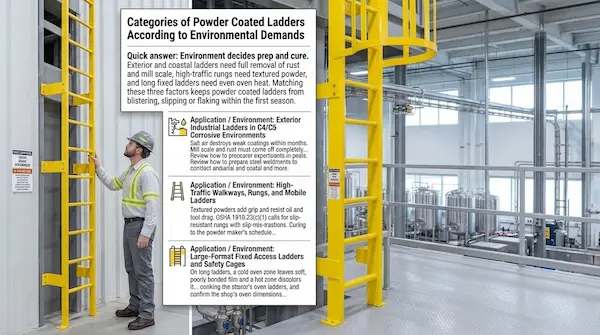
Categories of Powder Coated Ladders According to Environmental Demands
Quick answer: Environment decides prep and cure. Exterior and coastal ladders need full removal of rust and mill scale, high-traffic rungs need textured powder, and long fixed ladders need even oven heat. Matching these three factors keeps powder coated ladders from blistering, slipping or flaking within the first season.
Application / Environment: Exterior Industrial Ladders in C4/C5 Corrosive Environments
Salt air destroys weak coatings within months. Mill scale and rust must come off completely. If a ladder arrives with heavy scale or old paint, tell our team so we can confirm the prep route before drop-off. Review how to prepare steel weldments for powder coating before shipping.
Application / Environment: High-Traffic Walkways, Rungs, and Mobile Ladders
Textured powders add grip and resist oil and tool drag. OSHA 1910.23(c)(1) calls for slip-resistant rungs on portable metal ladders, so texture supports the ladder’s design but never replaces it. Curing to the powder maker’s schedule, often 360°F to 400°F, sets the film without burning the texture.
Application / Environment: Large-Format Fixed Access Ladders and Safety Cages
On long ladders, a cold oven zone leaves soft, poorly bonded film and a hot zone discolors it. Before shipping powder coated ladders of this size, confirm the shop’s oven dimensions and how it tracks the cure.
Quality Control, Surface Preparation, and Custom Projects with Richards Powdercoat
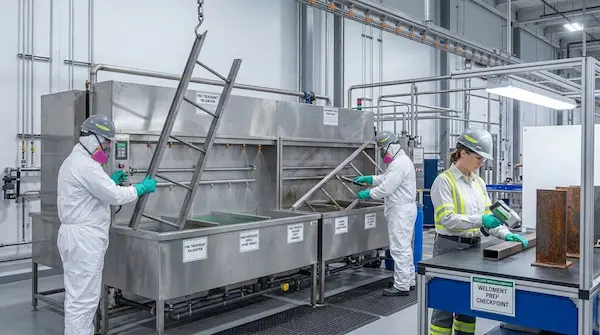
Quick answer: Coating quality is decided before the powder gun turns on. Chemical cleaning, phosphate pre-treatment and masking give the powder a clean surface to bond to, which prevents peel failures at welds and keeps powder coated ladders out of the repair queue during audits.
Surface Preparation Programs, Application, and Quality Assurance
- Chemical cleaning and degreasing: our prep team removes cutting fluids and oils that block adhesion.
- Phosphate pre-treatment: a conversion coating that improves adhesion and corrosion resistance on steel ladders and cages.
- Masking: threads and mounting holes stay clean.
- Electrostatic application and oven cure: full coverage on rung corners, welds and cage hoops.
- Final inspection: every batch is checked before release. Adhesion can be verified with the ASTM D3359 cross-hatch test when your spec requires it.
Long-Term Cost-Benefit Solutions for OSHA-Compliant Powder Coated Ladders
On-site repainting means downtime, containment, solvent fumes and long dry times, and touch-ups fail first at the same welds. Shop-finished powder coated ladders return ready to install, so the access point closes once instead of every season.
Heavy-Duty Powder Coating Services for Commercial, Industrial, and Custom Parts
Quick answer: Richards Powdercoat finishes ladders, cages and platforms that other shops fabricate. We prepare, coat and inspect parts in Dunn, North Carolina, so facility managers, OEMs and contractors get powder coated ladders back on schedule without running an in-house paint booth.
Refurbishments go through our industrial powder coating service for steel structures, and OEM ladder lines can be scheduled through production run processing. Safety colors are matched to RAL, Pantone or your sample.
If the ladder still has to be built, start with the documents needed for a custom aluminum fabrication quote and compare aluminum vs steel for commercial properties before choosing the base metal.
Frequently Asked Questions About OSHA-Compliant Powder Coated Ladders
Quick answer: Facility buyers usually ask about price, old coatings and safety colors first. Clear answers on these three points help you plan the budget, the prep and the color spec before powder coated ladders leave your facility for the coating line.
How much does it cost to powder coat an industrial ladder?
Cost depends on ladder length, cage size, surface condition, color and quantity. Send dimensions, quantity, condition and color through our quote form, and we respond within 24 business hours.
Can you powder coat a ladder that already has old paint or rust?
Powder should never go over old or unknown coatings: they blister or burn in the oven and the new film loses adhesion. The ladder must reach bare, clean metal first. Send photos of its condition with your quote request, and our team will confirm the prep needed before drop-off.
Can powder coated ladders be matched to OSHA safety yellow?
Yes. OSHA 1910.144 designates yellow for caution and marking physical hazards. We can match RAL and Pantone codes or a customer sample, so include the exact color reference in your specification.
Does powder coating meet OSHA’s requirements for corrosion protection on metal ladders?
Yes. OSHA 29 CFR 1910.23(b)(6) requires metal ladders to be corrosion-resistant or protected against corrosion. Oven-cured powder coating forms a continuous film that resists rust, moisture, and chemical exposure, satisfying this requirement when applied over a clean, pretreated surface.
How long does powder coating last on an industrial ladder?
A superdurable polyester system on pretreated steel typically lasts 15 to 20 years in outdoor industrial environments. Epoxy systems in chemical or indoor applications can exceed 20 years. A primer plus topcoat duplex system extends service life further in coastal or marine exposure.
Can Richards Powdercoat finish ladders fabricated by another shop?
Yes. Richards finishes parts fabricated by others. Ship to 109 East Devine St, Dunn, NC 28334. Include substrate, dimensions, coating spec, color (RAL or Pantone), and masking requirements with your quote request.
Conclusion
Shop-finished powder coated ladders are not a cosmetic upgrade. They are the most practical way to meet the OSHA requirement that metal ladders stay protected against corrosion, and to stop the same access points from showing up on every inspection report. The results depend on three decisions made before the parts leave your facility: choosing the powder chemistry that matches each environment, removing rust, mill scale and old coatings down to clean metal, and curing the film evenly from the first rung to the top of the cage. Get those right and your maintenance team stops chasing touch-ups, your safety audits close faster and your crews keep the routes they need to reach roofs, tanks and equipment.
Send the parts once, install them ready and keep your plant moving. Our team reviews every request and replies within 24 business hours.
Get your ladders coated and back in service
Send dimensions, quantity, condition and color. Our team replies within 24 business hours.
Prefer to talk first? Call +1 (919) 438-6103, email terry@richardsmetalfabrication.com or bring your parts to 109 East Devine St, Dunn, NC 28334.
Written by: The Richards Powdercoat Finishing Team · Last updated: October 23, 2026
Sources: