Table of Contents
Does Powder Coating Outlast Paint on Industrial Metal in North Carolina?
Powder coating usually lasts longer than conventional liquid paint on industrial metal parts because it builds a thicker, heat-cured film in a single coat. A powder coat can reach up to 120 µm in one pass, while a liquid coat typically deposits 25–30 µm per coat (IGP Pulvertechnik, 2016). In North Carolina, the statewide average is 49.6 inches of precipitation per year and summers stay humid (NCICS, 2022). There, that extra film and a phosphate pre-treatment slow rust creep and chipping. Real service life still depends on surface prep, powder chemistry and exposure. For fabricators near Dunn, Raleigh, the I-95 corridor and coastal markets such as Jacksonville, NC, Richards Powdercoat LLC applies powder over iron phosphate pre-treatment and inspects every batch before release.
Key takeaways
- A single powder coat can build up to 120 µm of film; liquid coats typically build 25–30 µm each (IGP Pulvertechnik TI 113, 2016).
- North Carolina averages 49.6 inches of precipitation per year, with hurricane-strength winds roughly every 3 years (NCICS State Climate Summary, 2022).
- ASTM B117 salt spray hours compare coatings; they do not predict lifespan. ASTM states that correlation with natural environments has “seldom” been established (ASTM B117-19).
- ISO 12944-1:2017 rates coating durability as low (up to 7 years), medium (7–15), high (15–25) and very high (over 25 years).
- Powder coatings are solvent-free and emit negligible VOCs, according to the Powder Coating Institute.
Powder coating is a dry finishing process that sprays electrostatically charged resin and pigment particles onto grounded metal, then cures them in an oven into a continuous, cross-linked film. Liquid paint is a solvent- or water-borne coating that forms its film as the carrier evaporates and the resin dries or cross-links.
How long does powder coating really last on industrial metal parts?
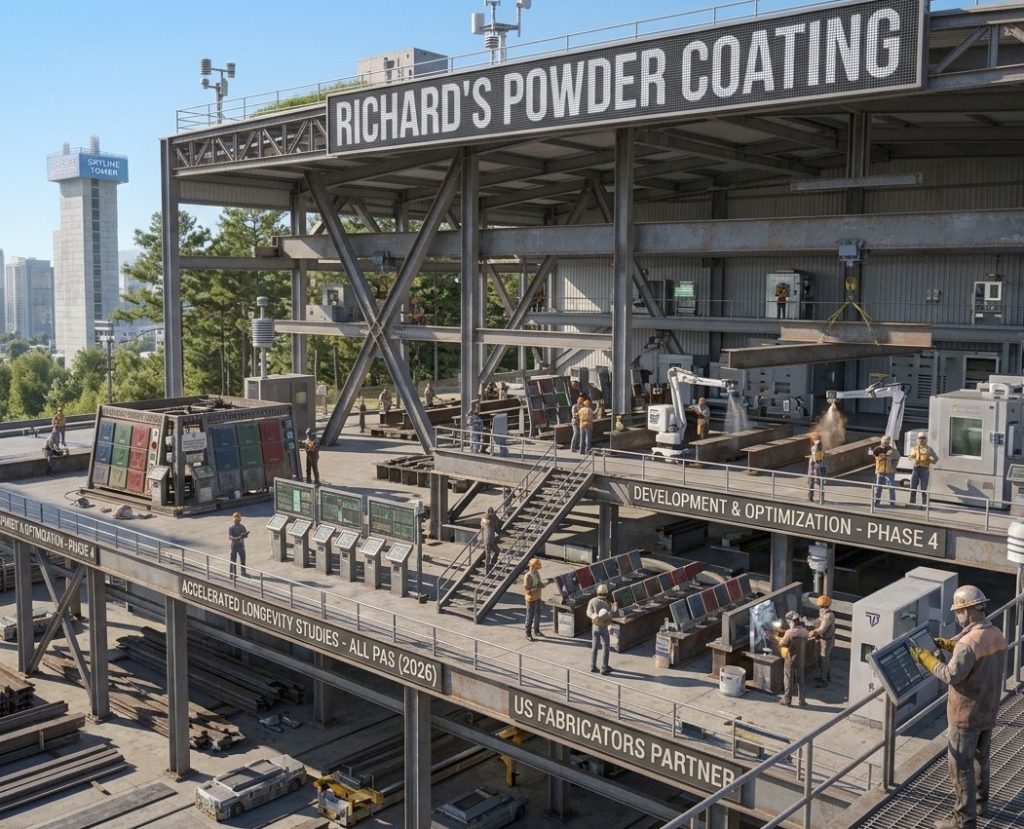
Powder coating on industrial metal parts can last well over a decade when the surface is properly pre-treated and the powder matches the exposure. No single number applies to every part. Service life depends on the substrate, pre-treatment, film thickness, powder chemistry, and whether the part sits indoors, outdoors or near chemicals.
Specifiers use ISO 12944-1:2017 to set a durability target. Its ranges describe the time to first major maintenance, not the total life of the part.
On coated steel, failure rarely starts in the middle of a flat panel. It starts at edges, welds and fastener holes, where film is thinnest or contamination remained.
What shortens the life of a powder-coated finish?
- Incomplete cleaning or degreasing before pre-treatment.
- Skipping a conversion coating such as iron phosphate.
- Thin film build on sharp edges and corners.
- Under-curing from low oven temperature or short dwell time.
- Using epoxy powder outdoors, where it chalks under UV.
Why does paint fail faster on metal in North Carolina’s climate?
Paint fails faster on metal in North Carolina because frequent moisture, summer heat and UV attack thin films at their weakest points. Once moisture reaches bare steel through a chip or pinhole, rust spreads under the coating. A single liquid coat leaves less material between the weather and the steel.
The NCICS State Climate Summary (2022) reports a statewide average of 49.6 inches of precipitation per year. The 2010–2020 period recorded the highest number of very warm nights (75 °F or above) on record.
Parts in eastern North Carolina, from powder coating in Fayetteville to the coast, also face salt-laden air and tropical storms. NCICS reports that hurricane-strength winds reach the state roughly every 3 years.
Liquid paint is not always the weak option. A well-specified multi-coat industrial system can perform very well. The usual problem is single-coat enamel or field paint over a poorly prepared surface.
What makes powder coating more durable than liquid paint?
Powder coating is more durable than most liquid paint because it applies 100% solids in one thick coat, then cross-links in an oven. The result is a dense film with strong edge coverage and impact resistance. Liquid paint loses solvent as it dries, so each coat leaves less film behind.
| Factor | Powder coating | Conventional liquid paint |
| Film per coat (µm / mils) | Up to 120 µm (≈4.7 mils) in one process | 25–30 µm (≈1–1.2 mils) per coat |
| Solids content (%) | 100% | Roughly 30–60%, by product |
| Cure | Oven, 160–200 °C (320–392 °F), about 15 min | Air dry or force dry; slower to handle |
| Adhesion | Depends on pre-treatment | Depends on pre-treatment |
| UV resistance | High with polyester; low with epoxy | High with polyurethane; lower with alkyd enamel |
| VOC emissions | Negligible | Releases solvents |
| Field touch-up | Difficult; needs shop recoat | Easy on site |
| Long-term cost driver | Fewer recoat cycles when specified correctly | Lower upfront cost; more maintenance in harsh exposure |
Sources: IGP Pulvertechnik TI 113 (2016); TIGER Drylac; Powder Coating Institute.
Surface preparation is the step that decides adhesion for both systems. See how Richards handles surface preparation and pre-treatment before any powder is applied.
Is powder coating worth the higher upfront cost for industrial parts?
Powder coating usually pays back its upfront cost when parts sit outdoors, get handled often, or are expensive to pull from service for repainting. The math depends on part count, size, prep and how often a painted part would need maintenance.
Compare cost per year of protection, not price per part. Add up the coating, equipment downtime, repaint labor and rework.
Richards Powdercoat LLC offers production run processing. Batching identical parts in one color spreads prep, masking setup and color changes across more pieces. The production run guide explains how pricing, MOQ and turnaround work for repeat orders.
When does liquid paint still make sense?
- Parts too large for the curing oven.
- Assemblies with heat-sensitive components that cannot be removed.
- Field repairs on installed structures.
- Non-conductive substrates without a conductive primer.
For structural steel exposed to heavy corrosion, also compare powder coating vs. galvanizing.
Which types of industrial metal parts benefit most from powder coating in NC?
The parts that benefit most combine outdoor exposure, frequent handling and high downtime cost. In North Carolina, that includes structural steel, machinery components, equipment housings and fabricated assemblies. Architectural aluminum profiles also gain from a uniform powder finish.
Richards Powdercoat LLC coats these part categories:
- Structural steel and fabricated assemblies.
- Machinery components and equipment housings.
- Aluminum extrusions, storefronts and window frames.
- Railing and fencing systems.
- Decorative metalwork.
Before shipping parts, flag every surface that must stay uncoated. Threads, bearing surfaces and assembly interfaces are masked before powder is applied.
Why is Richards Powdercoat LLC the right choice for industrial powder coating in NC?
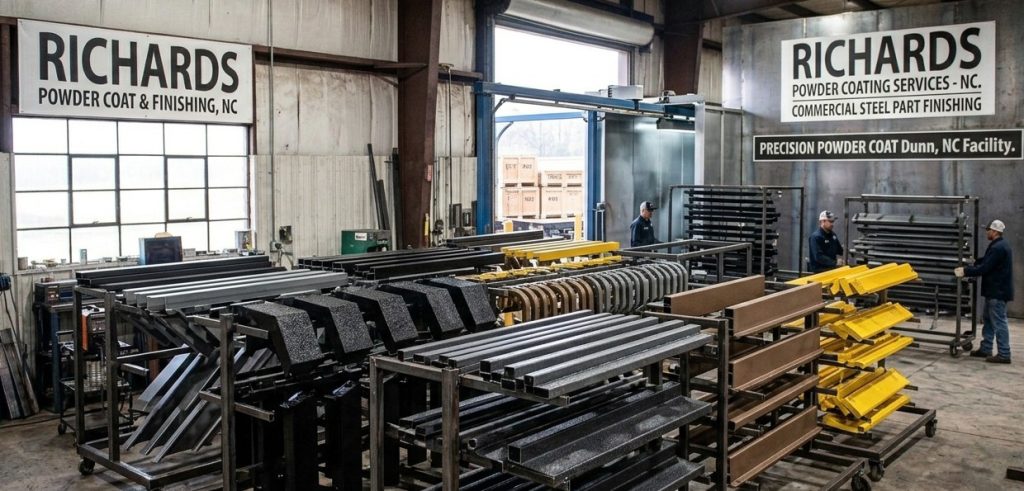
If you’re in Wake, Johnston or Harnett County, Richards Powdercoat LLC is a practical choice for industrial powder coating because its process is built around preparation. Every job moves through intake inspection, chemical cleaning, iron phosphate pre-treatment, masking, electrostatic application, controlled cure and batch inspection. The shop is in Dunn, Harnett County, with direct access to I-95.
- Process aligned with Powder Coating Institute guidelines.
- 100% of batches inspected before release.
- 100+ colors, RAL matching, plus textured, metallic and hammertone finishes. See the benefits of custom powder coating.
- One-off jobs to full production runs, with no fixed minimum order.
- Schedules set in advance for recurring production clients.
Learn more about Richards’ industrial powder coating service or how the shop works.
Ready to switch from paint to powder coating for your industrial parts?
Richards Powdercoat LLC serves industrial clients across Wake, Johnston, and Harnett County, NC. Call (919) 438-6103 or visit richardspowdercoat.com for a no-obligation quote.
Request a Quote
Frequently Asked Questions
How long does powder coating last vs. paint?
Powder coating generally outlasts single-coat liquid paint on the same part because it builds a thicker, oven-cured film. The exact figure depends on pre-treatment, resin and exposure. Use the ISO 12944 durability ranges to set a target for your parts.
Is powder coating better than paint for outdoor metal in North Carolina?
Yes, for most outdoor metal parts, as long as the powder is formulated for UV exposure, such as a polyester. North Carolina’s humidity and rainfall punish thin films. Epoxy powder is best reserved for indoor parts or as a primer.
Who does industrial powder coating for metal parts near Raleigh, NC?
Richards Powdercoat LLC, at 109 East Devine St, Dunn, NC 28334, coats industrial parts for fabricators, manufacturers and contractors across the region. The shop handles structural steel, machinery components, housings and fabricated assemblies, from one-off jobs to production runs. Call (919) 438-6103.
How much more expensive is powder coating than paint?
Powder coating usually costs more per part upfront but can cost less per year of protection. Price depends on quantity, size, geometry, prep and color. Batching parts into production runs lowers the per-unit cost.
Can you powder coat metal parts that are already painted?
Yes, but only after the existing paint is fully removed. Common methods include chemical stripping, abrasive blasting and burn-off ovens. Confirm with your coater which method suits your part.
Do salt spray hours tell you how long a coating will last?
No. ASTM B117 is a comparative lab test, and ASTM states that its results have seldom been correlated with performance in natural environments. Use salt spray hours to compare systems, not to promise years of service.
Sources
- IGP Pulvertechnik — TI 113: Powder coatings vs. liquid coatings (2016)
- NCICS — North Carolina State Climate Summary (2022)
- ASTM B117-19 — Standard Practice for Operating Salt Spray (Fog) Apparatus
- Powder Coating Institute — Environmental Impact
- TIGER Drylac — Liquid vs. Powder: The Pros and Cons
- Carboline — ISO 12944 brochure
Richards Powdercoat — November 2026