When a facility manager or general contractor calls us about a fixed access ladder, the conversation almost always starts the same way: “We need something that passes inspection the first time.” Fixed aluminum ladders have become the default choice for rooftop access, mezzanines, tank platforms, and equipment catwalks across the Southeast, and for good reason — aluminum resists corrosion, keeps installed weight down, and, when it’s properly fabricated and finished, holds up to decades of outdoor exposure without the maintenance headaches steel demands. But “properly fabricated” is doing a lot of work in that sentence. A fixed ladder that doesn’t meet OSHA 1910.23(d) isn’t just a liability — it’s a failed inspection waiting to happen. Below, we break down the specifications, fall-protection rules, and installation practices that separate a compliant ladder from a costly redo.
Why Fixed Aluminum Ladders Require Precision Engineering
A fixed aluminum ladder is a permanently mounted access structure used to reach elevated work areas — roofs, platforms, tanks — and, unlike portable ladders, it falls under a distinct set of OSHA load, spacing, and fall-protection requirements the moment it’s bolted in place.
Fixed ladders aren’t scaled-up versions of the aluminum ladder in your garage. Because they’re a permanent part of a building or structure, they’re engineered assets — designed load paths, welded or riveted joints, and mounting hardware rated for repeated industrial use. That’s a different discipline than portable ladder manufacturing, and it’s why so many facilities end up calling a metal fabricator rather than an equipment supplier.
Aluminum vs. Steel: Choosing the Right Material for Fixed Access Ladders
Steel is still common on heavy industrial sites where impact resistance matters more than weight, but for most commercial applications — rooftop HVAC access, warehouse mezzanines, architectural rooflines — aluminum wins on three fronts: it’s roughly a third the weight of steel (which matters for structural load calculations on existing roofs), it forms a natural oxide layer that slows corrosion, and it doesn’t need the same frequency of rust treatment. We often pair fixed aluminum ladder projects with our custom architectural aluminum fencing work, since the same fabrication standards — clean welds, tight tolerances, consistent finish — apply to both.
Where Fixed Aluminum Ladders Are Typically Installed
- Rooftop access points for HVAC and mechanical equipment
- Mezzanine and catwalk access in warehouses and distribution centers
- Water tank, silo, and tower access
- Loading dock and elevated platform access
- Architectural roof access on commercial and institutional buildings

Specifications Every Fabricator Must Follow
OSHA’s fixed ladder standard, 29 CFR 1910.23(d), sets exact requirements for rung spacing, load capacity, clearance behind the ladder, and side-rail extension — and every dimension is measured, not estimated, during an inspection.
This is the section that trips up fabricators who don’t specialize in code-driven metalwork. OSHA doesn’t leave much room for interpretation here, and the numbers are specific enough that a quarter-inch miss can fail an inspection.
Rung Spacing, Load Capacity, and Clearance Requirements
Under 1910.23(d), every fixed ladder we build has to meet the same baseline dimensions:
| Requirement | OSHA Specification |
|---|---|
| Rung/step spacing | Uniform, between 10″ and 14″ on center |
| Minimum load capacity | Must support the maximum intended load |
| Clearance behind rungs | 7″ minimum from rung centerline to the nearest fixed object (4.5″ for elevator pits) |
| Side-rail extension above landing | At least 42″ above the access level |
| Grab bar protrusion | Must not overhang the climbing side beyond the rungs |
We treat this table as the starting checklist on every fixed aluminum ladder quote — not a reference we consult after the fact. A ladder that’s close to compliant is a ladder we redesign before it ever reaches the shop floor.
Fall Protection Rules for Ladders Over 24 Feet
Once a fixed ladder rises 24 feet or more, OSHA requires a fall protection system — no exceptions. That’s roughly 24 rungs at standard spacing, which is an easy field check for anyone verifying an existing structure.
Cages, Wells, and Personal Fall Arrest Systems Explained
Historically, facilities relied on cages or wells bolted around the ladder as the fall-protection method. OSHA’s updated rule changed that: cages and wells are being phased out as a stand-alone solution in favor of ladder safety systems or personal fall arrest systems, which offer more reliable protection during an actual fall event. Employers can still combine a cage with one of these systems, as long as the cage doesn’t interfere with how the system functions.
Deadlines for Retrofitting Existing Fixed Ladders
- Fixed ladders installed before November 19, 2018, with cages already in place have up to 20 years from that date to add a ladder safety or personal fall arrest system.
- Fixed ladders installed on or after November 19, 2018, must include a ladder safety system or personal fall arrest system from day one — cages alone no longer satisfy the requirement for new installations.
If you’re planning a retrofit rather than new construction, this is the first question we ask: when was the existing ladder installed, and does its current fall protection still meet the standard for its install date?
Installation Best Practices for OSHA-Compliant Aluminum Ladders
Meeting the spec sheet is only half the job — the ladder also has to be mounted to a structure that can carry the load, finished to resist the environment it’s installed in, and inspected on a schedule that catches wear before it becomes a hazard.
Site Preparation and Structural Mounting
Before we fabricate anything, our team verifies the mounting surface — roof deck, tank shell, mezzanine frame — can actually bear the ladder’s rated load plus the dynamic load of a person climbing it. This isn’t a formality. Undersized mounting hardware or a weak substrate is one of the most common reasons a ladder that looks fine on paper fails a physical load test.
Finishing and Corrosion Protection
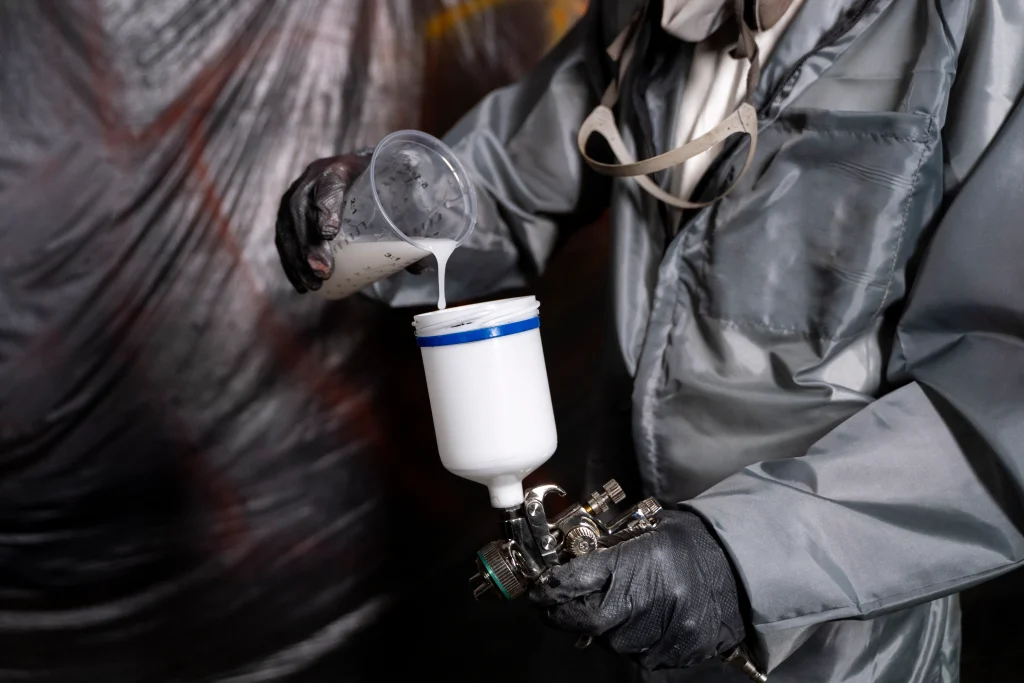
Aluminum resists rust on its own, but raw aluminum in an industrial or coastal environment still benefits from a protective finish, especially at weld points where the base metal is exposed. We start with proper weld preparation — you can see how we approach it in our guide on how to prepare steel weldments for powder coating — and follow it with a powder coat finish engineered for long-term outdoor exposure. If you want the technical side of why that finish outlasts wet paint, our breakdown of powder coating durability covers the chemistry behind it.
Maintenance Scheduling After Installation
A fixed aluminum ladder isn’t a “set it and forget it” structure. We recommend a documented visual inspection at least twice a year — checking rung tightness, weld integrity, side-rail corrosion, and the condition of any fall-arrest hardware — with more frequent checks in coastal or high-humidity environments. Our powder coating maintenance and care guide walks through what to look for between full inspections, so the finish (and the structure underneath it) keeps performing the way it did on install day.

Working With a Fabricator Who Understands Both Metal and Code
This is really the heart of it: a fixed aluminum ladder sits at the intersection of structural engineering, metal fabrication, and regulatory compliance. Get any one of those wrong and the whole project is at risk — whether that’s a failed OSHA inspection, a ladder that corrodes faster than it should, or a mounting system that can’t carry the load it was designed for. Our shop handles the full cycle in-house, from fabrication through finishing, and we make drop-off and pickup logistics simple for contractors managing multiple job sites at once, so a ladder project doesn’t turn into a scheduling headache on top of everything else.
Frequently Asked Questions

Does OSHA require fall protection on every fixed aluminum ladder?
No. Fall protection — a ladder safety system, personal fall arrest system, or in some cases a cage combined with one of those systems — is required once a fixed ladder reaches 24 feet in height. Shorter fixed ladders still have to meet OSHA’s general rung-spacing, load, and clearance rules, but they don’t trigger the fall-protection requirement on their own.
Is aluminum strong enough for a fixed ladder rated for industrial use?
Yes, when it’s engineered correctly. Aluminum’s strength-to-weight ratio is well suited to fixed ladder applications, and a properly designed aluminum ladder meets the same OSHA load requirements as a steel one. The material choice affects weight and corrosion resistance far more than it affects load capacity, as long as the gauge and joint design are specified correctly.
Can an existing fixed ladder with a cage still be brought up to code?
In most cases, yes. If the cage was installed before November 19, 2018, OSHA allows up to 20 years from that date to add a ladder safety or personal fall arrest system. A retrofit typically involves adding a rail-mounted safety system rather than replacing the entire ladder structure, which keeps the cost well below a full rebuild.
Conclusion
A fixed aluminum ladder looks simple from the ground, but the standard behind it — OSHA 1910.23(d) — leaves very little margin for guesswork on rung spacing, clearance, load rating, and fall protection. Getting it right means working with a fabricator who treats the code as part of the design process, not a checklist applied after the welds are already made. If you’re planning a new installation or need an existing ladder brought up to current standards, our team can walk your project from initial specs through a finished, code-compliant structure — reach out and we’ll start with a site assessment.
join our social networks to stay updated with our latest news and events. Don’t miss out on anything and follow our accounts today! Contact us!
For industrial and commercial ladder finishing in the region, Richards Powdercoat LLC provides professional powder coating for ladders in North Carolina — corrosion-resistant finishes for steel and aluminum ladders, applied with full surface pre-treatment.